

TerraCore: how what nobody used to measure becomes visible
TerraCore: an agribusiness management platform that centralizes operations and field records in one system.

Not every operation fails from lack of work. Many fail because nobody can actually see what is happening.
In agriculture the information exists, but it is scattered: records in notebooks, decisions based on memory, processes that do not talk to each other. When the time comes to scale, optimize or show results, the same old problem shows up: there is no clarity.
TerraCore is the answer to that. It is an agribusiness management platform that replaces Excel, notebooks and WhatsApp with one centralized system, where animals, crops, supplies, production and animal health live connected. It is built for mid-sized farms and companies in the Colombian agricultural sector, with a focus on Urabá.
One system, not a collection of loose modules
TerraCore does not aim to digitize for the sake of it. It aims for something more concrete: control over what is happening today and clarity about what should happen tomorrow.
The platform recognizes the type of operation of each account (livestock, crops or mixed) and adjusts which modules make sense to show. A livestock operation sees Animals and Animal health; a crop operation sees Crops; a mixed one sees everything. That decision is not cosmetic: it keeps the system from feeling generic in a sector where livestock and crops work differently.
Animals
An animal stops being a loose record. Each one has its type and breed, its weight, its health status, its location and what it cost, without depending on the foreman's memory or on notebooks that get lost. Its vaccines are recorded on the same animal.

Supplies
A supply stops being just an expense and becomes a direct impact on the result: what was used, what it is worth and in which batch it was consumed. Every supply has a minimum quantity, and TerraCore flags it as critical when it falls below it, before the feed runs out and you have to make an emergency purchase.

Production
Production stops being an estimate and becomes a measurable flow. Each batch is recorded with what it produced and the supplies it consumed, and TerraCore shows how much is produced each month compared to the previous one.

Animal health
Health stops being reactive and becomes constant follow-up: which vaccine each animal received, when, at what dose, who applied it and when the next one is due. The date of the next dose goes into a vaccination calendar, with weekly and monthly views, so you can see what is coming ahead of time.


Crops and finance
For crop operations, the Crops module keeps a record of each crop with its type, variety, hectares, planting date and status, with search and filters.
Finance lives in the same system as the operation, as a read-only screen: the month's summary and the history. Every figure comes from what was already recorded in the field, so they are estimates, and if a record is missing a price or a cost, that part adds up to zero.
One screen to decide
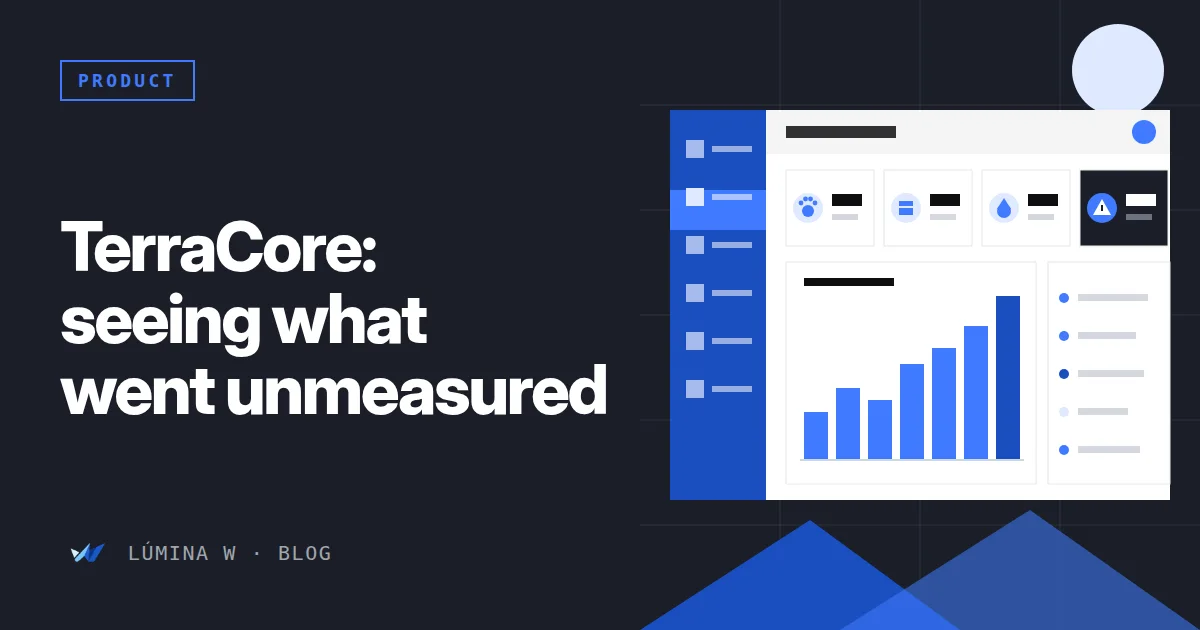
When all the information is connected, you stop operating on intuition and start spotting problems before they escalate. The Central Dashboard brings together on one screen the active animals, the month's production compared to the previous month, the supplies available and how many are at a critical level, along with upcoming vaccines and the team's recent activity.


The dashboard does not try to show more data. It tries to show what needs attention today. That is the difference between storing data and being able to use it.
Offline-first, because the countryside does not always have signal
A central architecture decision in TerraCore is that daily operation works without a connection: data is saved on the device and changes sync on their own when the signal comes back, which is essential in rural operations where the internet is not always stable. Animals, crops, supplies, production and animal health can be viewed, searched, created and edited without internet, and the dashboard and the Finance figures are computed on the device itself.
What always needs internet is whatever involves security or money: signing up, signing in, recovering or changing the password and anything to do with paying.
That brings a classic offline problem: what happens when two devices edit the same data without having seen each other. TerraCore solves it by versioning every record: each change raises the version, and if a device tries to send an old copy, the system detects a conflict instead of overwriting what someone else already saved.
Inventory adjustments made offline are sent as a difference, not as an absolute value. It matters because if two people adjust the same stock while offline, adding or subtracting an amount does not erase the other person's adjustment, while setting an absolute value would.
Roles and permissions
TerraCore separates two roles with different permissions: whoever administers the account, with control over users, sites and subscription, and whoever operates and records data day to day, without being able to delete. That separation exists because in a mid-sized operation not everyone needs the same level of access, and giving it to everyone for convenience is an unnecessary risk.
What we learned integrating the modules
Building TerraCore as a connected system, and not as independent modules, forced us to make explicit decisions about how they relate to each other: an animal health record can deduct supply stock, and a production batch deducts the supplies it used.
That coherence between modules is the least visible part of the product, and also the one that took the most design time: it is easier to build five loose screens than a system where every screen knows what happens in the others.
The central idea stays simple: it is not about having more data, but about better understanding what is already happening, and making decisions with that advantage.
Comments
0 repliesSign in to comment, like and save posts.
No comments yet. Start the conversation.